We Offer Customised Solutions For Your City
Please select your city to proceed
 Ahmedabad
 Gandhinagar
 Gurgaon
 New Delhi
 Noida
Noida
Please select your city to proceed
Ahmedabad
Gandhinagar
Gurgaon
New Delhi
Noida
Apply the 1MONTHFREE coupon code at checkout and get 1 Month Free. 🎉
Access your account to manage orders, update your information, and stay in control of your purchases.
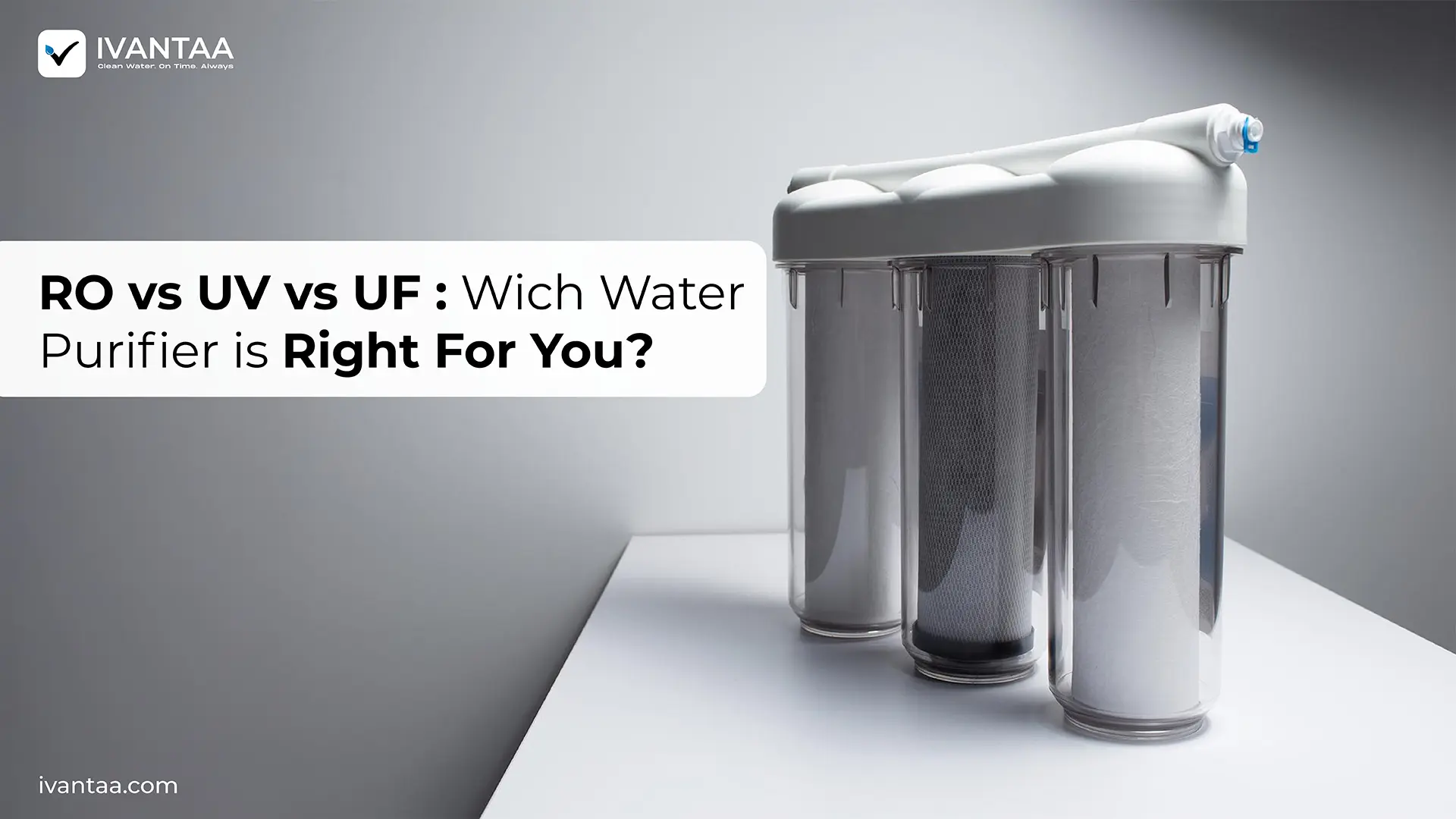
Clean drinking water is no longer something we can take lightly. With rising pollution levels, changing water sources, and inconsistent municipal supply, choosing the right purifier has become a serious household decision. If you have been comparing models and feeling confused about the RO vs UV vs UF water purifier debate, you are not alone.
Many of us simply search for the best water purifier for drinking water and end up overwhelmed with technical jargon. Let us simplify everything so you can confidently decide what works for your home or business.
Water quality varies drastically depending on your city, building pipeline, and water source. Some homes receive borewell water with high TDS. Others rely on municipal water that may contain microbial contamination.
According to the World Health Organization, contaminated drinking water contributes to waterborne diseases affecting millions globally.
This makes drinking water safety a daily priority. The right water purifier for home use does more than improve taste. It protects your family from long-term health risks caused by bacteria, heavy metals, and chemical contaminants.
Before deciding which water purifier is best, you must first understand how each technology works.
There are three main types of water purifiers used in Indian households and commercial spaces.
1. RO Purifier
RO stands for Reverse Osmosis. This technology uses a semi-permeable membrane to remove dissolved salts, heavy metals like lead and arsenic, fluoride, and other chemical contaminants.
RO is ideal for water with high TDS levels. It improves taste and reduces hardness significantly.
2. UV Purifier
UV purification uses ultraviolet light to kill bacteria and viruses. It is effective against microorganisms but does not remove dissolved solids or chemicals.
UV systems are suitable where water has low TDS but may contain biological contamination.
3. UF Purifier
UF stands for Ultrafiltration. It uses a hollow fiber membrane to remove bacteria, cysts, and suspended particles. It does not remove dissolved salts or heavy metals.
Some common UF water purifier benefits include low maintenance, no electricity requirement in gravity models, and effective filtration of visible impurities.
Understanding these types of water purifiers helps you compare realistically instead of choosing based on brand popularity.
Feature | RO Purifier | UV Purifier | UF Purifier |
Removes Dissolved Salts (TDS) | Yes | No | No |
Removes Heavy Metals (Lead, Arsenic, etc.) | Yes | No | No |
Removes Chemicals | Yes | No | No |
Removes Bacteria & Viruses | Yes (with membrane + often UV support) | Yes | Yes (bacteria, some microbes) |
Removes Suspended Particles | Yes | No | Yes |
Suitable for High TDS Borewell Water | Yes | No | No |
Suitable for Low TDS Municipal Water | Yes | Yes | Yes |
Electricity Required | Yes | Yes | Not always (gravity UF available) |
Ideal For | Chemically contaminated or hard water | Microbially contaminated but low TDS water | Low TDS water with visible impurities |
This is where it becomes personal.
Imagine a family living in Delhi NCR receiving borewell water with TDS of 700 ppm. They install a UV purifier, thinking it will be enough. While bacteria may be neutralized, the high dissolved solids remain. The water tastes salty, and scale builds up in appliances.
After switching to an RO purifier vs UV purifier setup, TDS reduces to safe levels, taste improves, and scaling decreases. The change is noticeable within weeks.
On the other hand, consider a household receiving treated municipal water with TDS around 150 ppm. Installing a high-capacity RO system might unnecessarily remove essential minerals and waste water. In this case, UV or UF could be sufficient.
If you are still wondering which water purifier is best, the answer depends on three things:
For most urban homes with unpredictable water quality, RO combined with UV offers balanced protection.
Let us clear up a few misconceptions.
Myth 1: RO water removes all healthy minerals
Modern RO systems come with mineral cartridges that reintroduce essential minerals in balanced amounts.
Myth 2: UV is enough for all water sources
UV does not remove dissolved salts or chemicals. It only addresses microbial contamination.
Myth 3: UF works the same as RO
UF membranes are larger and cannot filter dissolved impurities.
The UV vs UF vs RO water purifier debate often gets simplified into brand marketing claims. In reality, suitability depends entirely on water quality.
Before purchasing a water purifier for home or commercial use, evaluate the following:
1. Check TDS Level
If TDS is above 300 ppm, RO is generally recommended.
2. Identify Contamination Type
Is the issue bacterial, chemical, or both?
3. Water Source
Borewell water usually requires RO. Municipal water may require UV or UF.
4. Budget and Maintenance
RO systems may require periodic membrane replacement. UV and UF have relatively lower maintenance costs.
5. Household Size
Choose storage capacity based on daily water consumption.
Making a decision without these checks often leads to overspending or underprotection.
Choosing between RO, UV, and UF is not about picking the most expensive model. It is about matching technology with your water quality.
The RO vs UV vs UF water purifier discussion becomes simple once you understand what each system removes. RO handles dissolved solids and heavy metals. UV handles bacteria and viruses. UF handles suspended particles and microbes.
If your water quality is uncertain or TDS fluctuates frequently, an RO-based system with additional UV protection is often the safest long-term choice.
Safe drinking water is not just about clarity. It is about invisible protection.
Safe drinking water is not just about clarity. It is about invisible protection.
Still unsure which purifier fits your home?
Get your water tested and explore purification solutions designed specifically for your area. Whether you need RO, UV, or UF technology, choosing the right system today can protect your family for years to come.
Explore Ivantaa’s reliable water purification solutions and rental plans designed for modern homes. Make every glass of water not just clear, but truly safe.
Typically, the time required to install a water filter will range from 30 to 45 minutes. If the installation is taking longer than this time, then there is usually an issue with the installation being done correctly.
Yes, installing a water filter by yourself is possible if you are knowledgeable about the basics of plumbing. However, a lack of knowledge may lead to small mistakes being made that result in leaks and preventable loss of time.
If your tap water runs slowly, it is an indication that your water pressure is too low for an RO purifier. It requires a constant flow of water at a sufficient pressure in order to operate correctly.
The best location to install your water purifier in your home is near the kitchen’s water line, drain, and power outlet access; convenience takes precedence over concealment.
After the water purifier has been installed, pre-filters must be replaced every six to twelve months. If the pre-filters are replaced regularly on time, this will extend the longevity of the RO membrane.
Log in or sign up to manage your orders and account details.
By continuing, you agree to our Terms & Conditions and Privacy Policy.