Please select your city to proceed
Ahmedabad
Gandhinagar
Apply the 1MONTHFREE coupon code at checkout and get 1 Month Free. 🎉
Access your account to manage orders, update your information, and stay in control of your purchases.
If you’ve ever opened your RO purifier and seen that grimy first filter, you already know how much dirt and debris your water carries before purification even begins. That first line of defence is usually a spun filter or a sediment filter, two terms most people use interchangeably.
But here’s the catch: they aren’t the same. And choosing the wrong one can bring down the performance of your RO system, increase maintenance costs, and even reduce filter life.
Before water even touches the RO membrane, it passes through pre-filters. These filters remove dust, mud, rust flakes, sand, silt, and floating debris. Without them, the RO membrane would choke faster, your purifier would need more frequent maintenance, and the output water flow would drop drastically.
A study published on ScienceDirect found that suspended particles significantly reduce membrane efficiency and increase operating pressure requirements in RO systems.
That is exactly why the right type of pre-filtration is essential.
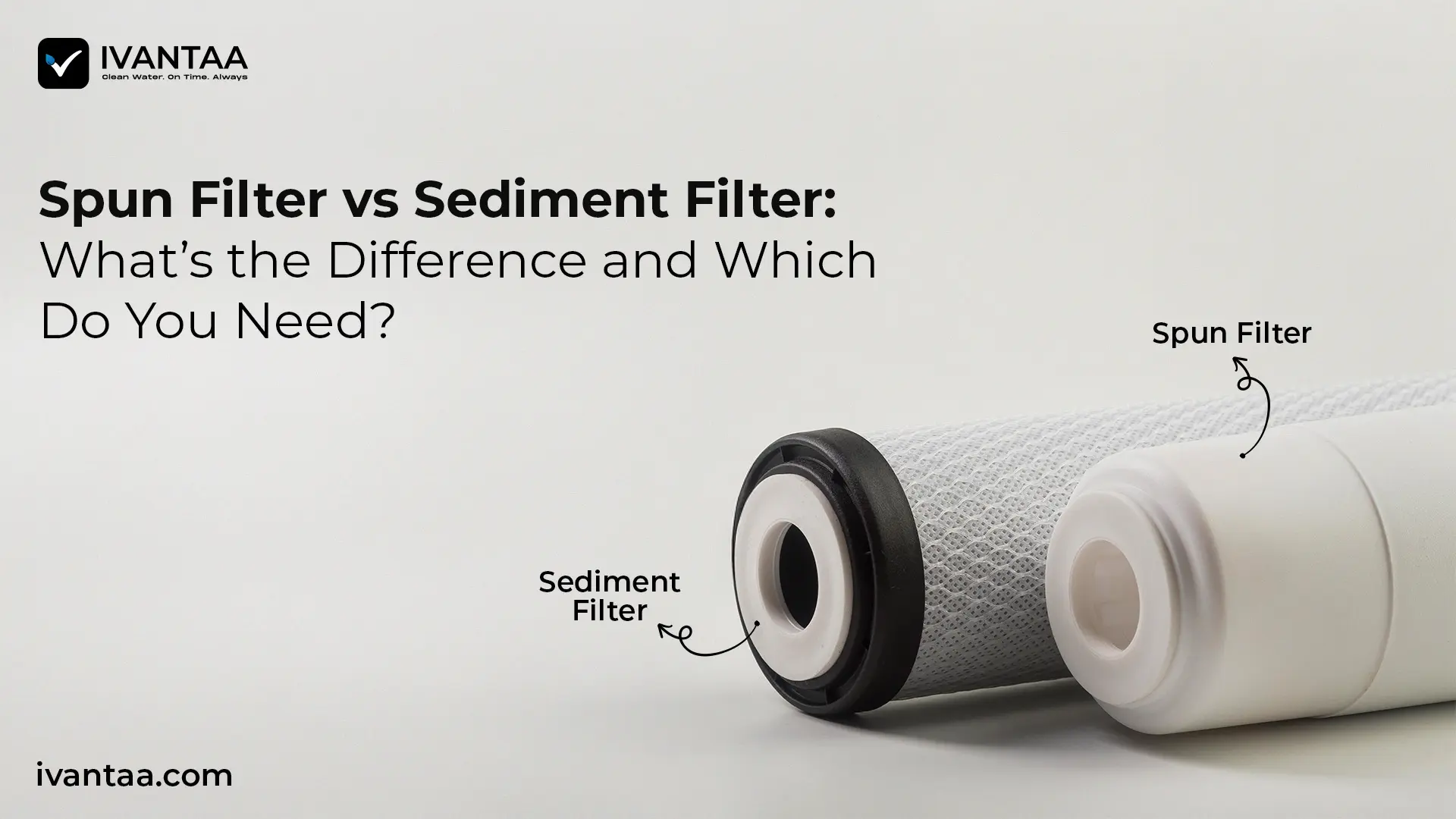
A spun filter (also called a melt-blown filter) is made by spinning polypropylene fibres into a thick, layered cylinder. As water passes through the layers, larger dirt particles get trapped on the outer surface while finer particles get caught deeper inside.
Mainly to catch:
If your water looks muddy or leaves brownish residue in buckets or taps, a spun filter is the first thing your purifier needs.
A sediment filter (often a pleated or mesh-style filter) works differently. Instead of depth filtration, it traps particles on the surface. These filters usually come with a fixed micron rating, like 5-micron or 10-micron, which determines the particle size they can block.
To remove:
If your water looks clear but leaves faint white or brown specks on utensils, a sediment filter will handle that well
Below is a clear comparison to help you understand the real difference between spun and sediment filters:
Feature | Spun Filter | Sediment Filter |
Filtration type | Depth | Surface |
Particle capture | Larger + medium particles | Small fine sediments |
Durability | Shorter life (2–3 months) | Longer life (up to 6 months) |
Washability | No | Sometimes yes |
Best for | Muddy, turbid water | Municipal supply with light dirt |
Cost | Low | Slightly higher |
Both filters remove impurities, but the difference between spun and sediment filter variations becomes crucial depending on your water supply. When you compare spun filter vs sediment filter, the best choice ultimately depends on the type of sediments present and how heavily your household water load affects the pre-filter stage.
Here’s a simple rule:
If your water is muddy or from a borewell
Go for a spun filter.
It handles a heavy dirt load far better.
If your water comes from a municipal supply
Choose a sediment filter.
It improves clarity and stops fine particles.
Example
Rahul from Ahmedabad installs an RO system. His apartment gets slightly yellowish borewell water that leaves visible dirt at the bottom of his water bucket.
If he uses only a sediment filter, it will choke within weeks. After switching to a spun filter designed for heavy turbidity, not only does the dirt reduce drastically before entering the RO, but the RO membrane life also improves. Rahul ends up spending less on maintenance and filter replacements throughout the year.
Both filters have strengths. The real question is: what does your water need?
Consider these factors:
Most RO companies recommend using a spun filter at the inlet for heavy load and a sediment filter next in line for finer purification. This combination ensures the RO membrane faces minimal stress.
If you’re looking for a complete setup without the hassle of installation and maintenance, opting for a water purifier for rent or an RO on rent is becoming increasingly popular in cities like Ahmedabad. Many rental providers like Ivantaa offer regular pre-filter replacements as part of the plan, so you never have to worry about clogged filters or surprise servicing charges.
Proper maintenance ensures your RO membrane lasts longer and your drinking water remains safe.
Both spun and sediment filters are essential in water purification, but their roles differ. If your water is visibly dirty or comes from borewell sources, a spun filter is your best choice. If your water is relatively clear but contains fine particles, a sediment filter offers better long-term performance.
For many households, using both in sequence provides the best protection.
And if you want the convenience of zero maintenance, scheduled servicing, and free filter replacements, choosing a water purifier rental plan is far more affordable and stress-free. Many residents in Ahmedabad now prefer RO on rent over buying, thanks to transparent pricing and fast support.
Ready to upgrade your drinking water experience?
Explore affordable, hassle-free RO on rent plans with free installation, regular filter changes, and no hidden fees. Pure water shouldn’t feel complicated; make it effortless today. Contact Ivantaa Today
Yes, and it’s actually ideal. Spun filters catch heavy particles, while sediment filters handle finer dust.
If the flow reduces or your water tastes different, it’s time to replace the filter.
No. They remove only suspended particles, not dissolved solids.
Most areas use borewell water mixed with municipal supply, so a spun filter at the inlet and a sediment filter next is the most effective combination.
Log in or sign up to manage your orders and account details.
By continuing, you agree to our Terms & Conditions and Privacy Policy.