We Offer Customised Solutions For Your City

Please select your city to proceed

Ahmedabad
Gandhinagar
Gurgaon
New Delhi
Noida

Ivantaa

Apply the 1MONTHFREE coupon code at checkout and get 1 Month Free. 🎉

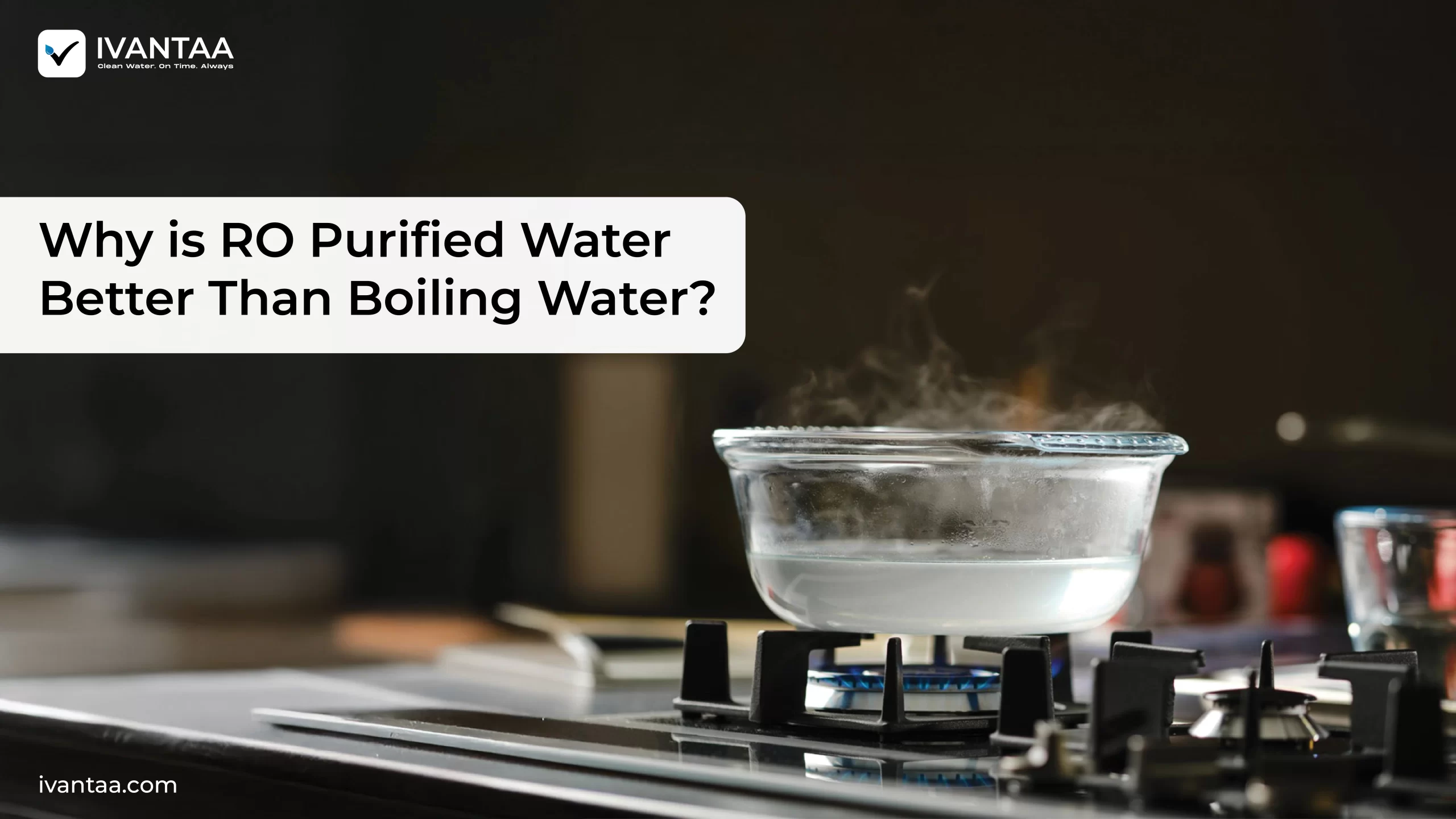
Why Is RO Purified Water Better Than Boiling Water?

Clean drinking water is something most of us assume we already have. Turn on the tap, boil the water if needed, and it should be safe. That belief worked decades ago, but today water contamination is more complex. Industrial waste, aging pipelines, dissolved salts, and heavy metals have changed the definition of safe drinking water.

If you have ever wondered whether boiling water is enough, or whether investing in a purifier actually makes sense, you are not alone. Many households still rely on boiling water for drinking, while others swear by modern purification systems.

What Is Boiled Water?

Boiling water is one of the oldest water purification methods known to us. The process is simple. Heat water to 100°C and keep it boiling for a few minutes. This kills most bacteria, viruses, and parasites that cause waterborne diseases.

Boiled water for drinking is effective in emergencies and for short-term use. It is often recommended during floods or when the water supply is temporarily unsafe.

However, boiling does not remove dissolved impurities. If your tap water contains excess salts, fluoride, nitrates, arsenic, or lead, boiling may actually increase their concentration because some water evaporates while contaminants remain.

According to the World Health Organization, boiling improves microbiological safety but does not remove chemical contaminants or heavy metals.

What Is RO Purified Water?

RO Purified Water is produced using Reverse Osmosis technology. In this process, water passes through a semi-permeable membrane that blocks dissolved solids, harmful chemicals, and heavy metals. Most modern systems also include UV or UF stages for microbial safety.

RO water benefits go beyond killing germs. It targets invisible contaminants that boiling simply cannot address. This makes it a preferred solution for long-term home use, especially in cities where water quality varies from area to area.

How Boiling and RO Purification Work

Let us simplify this.

Boiling water works by heat. Heat destroys microorganisms but leaves physical and chemical impurities untouched.

RO purification works by pressure. Water is forced through a membrane fine enough to stop dissolved salts, heavy metals, pesticides, and other contaminants. When paired with UV, it also ensures bacteria and viruses are neutralized.

This difference alone explains why water filter vs boiling water is not an equal comparison. One improves safety partially; the other addresses safety at multiple levels.

RO Purified Water vs Boiling Water: Key Differences

When comparing filtered water vs boiled water, these are the real-world differences that matter.

  • Impurity Removal
    Boiling kills germs but does not remove TDS, heavy metals, or chemicals. RO removes dissolved solids, arsenic, lead, fluoride, and industrial pollutants.
  • Taste and Odor
    Boiled water often tastes flat or metallic due to concentrated salts. RO water tastes lighter and cleaner because excess minerals and contaminants are removed.
  • Energy and Effort
    Boiling requires gas or electricity daily, time for cooling, and storage hygiene. RO systems work on demand with minimal effort.

  • Consistency
    Boiling quality depends on time and temperature. RO delivers consistent purification every time.

Example

A family living in an urban apartment where tap water TDS is around 600 ppm. They boil water daily, believing it is safe.

After boiling, bacteria may be gone, but dissolved salts, fluoride, and trace metals remain. Over time, the family notices scale buildup in utensils, bitterness in tea, and stomach discomfort.

When they switch to RO water for home use, TDS drops to a balanced level. Tea tastes better, digestion improves, and they no longer worry about what is invisible in their water.

This is not an extreme case. It is a common urban reality.

When Is Boiling Water Still Useful?

Boiling water still has its place. It is useful when:

  • There is a temporary contamination alert
  • You are traveling or camping
  • Power or purifier systems are unavailable
  • Water quality is already low in TDS and chemicals

For short-term drinking water safety, boiling is effective. But relying on it daily assumes your water has no chemical or heavy metal contamination, which is rarely verified.

Why RO Purified Water Is the Better Choice for Daily Use

Daily hydration is not about emergency survival. It is about long-term health.

RO water benefits include protection from heavy metals, controlled mineral balance, better taste, and consistent safety. Unlike boiling, RO purification adapts to modern water challenges.

The debate of RO Purified Water vs Boiling Water ultimately comes down to what risks you want to ignore. Microbes are only one part of water safety. Chemical contamination is the silent problem.

For families with children, elderly members, or anyone consuming water throughout the day, RO offers peace of mind that boiling cannot fully provide.

Understanding TDS and Why It Matters

TDS stands for Total Dissolved Solids. It includes salts, minerals, and metals dissolved in water.

Low TDS water tastes flat. Extremely high TDS water strains the kidneys and affects digestion. Safe drinking water usually falls between 50 to 300 ppm depending on source and health needs.

RO systems regulate TDS effectively, while boiling water does nothing to control it. This is a key reason why water filter vs boiling water comparisons consistently favor RO for daily use.

Conclusion

Safe drinking water today requires more than heat. While boiling water removes bacteria, it does not address the full spectrum of contaminants present in modern water supplies.

RO purification combines technology, consistency, and convenience. For households looking to rent an RO water purifier, this approach offers a practical way to meet today’s water quality challenges without long-term commitments. It aligns better with modern health expectations and sustainable living needs.

If your goal is truly safe drinking water, and not just habit-based safety, choosing to rent an RO water purifier becomes the smarter, more flexible choice.

Still boiling water every day and hoping it is enough?
Upgrade your daily hydration with an RO purification system designed for modern homes. Enjoy better taste, consistent safety, and zero daily effort.

Explore Ivantaa’s RO rental options today and experience what clean water should actually feel like.

FAQs

Can I use a spun filter and a sediment filter together in one system?

Yes, and it’s actually ideal. Spun filters catch heavy particles, while sediment filters handle finer dust.


If the flow reduces or your water tastes different, it’s time to replace the filter.


No. They remove only suspended particles, not dissolved solids.

Most areas use borewell water mixed with municipal supply, so a spun filter at the inlet and a sediment filter next is the most effective combination.

IVANTAA

Welcome

Log in or sign up to manage your orders and account details.

+91

By continuing, you agree to our Terms & Conditions and Privacy Policy.

IVANTAA

Welcome

Enter OTP sent to

30s remaining |

IVANTAA

Complete Your Profile